

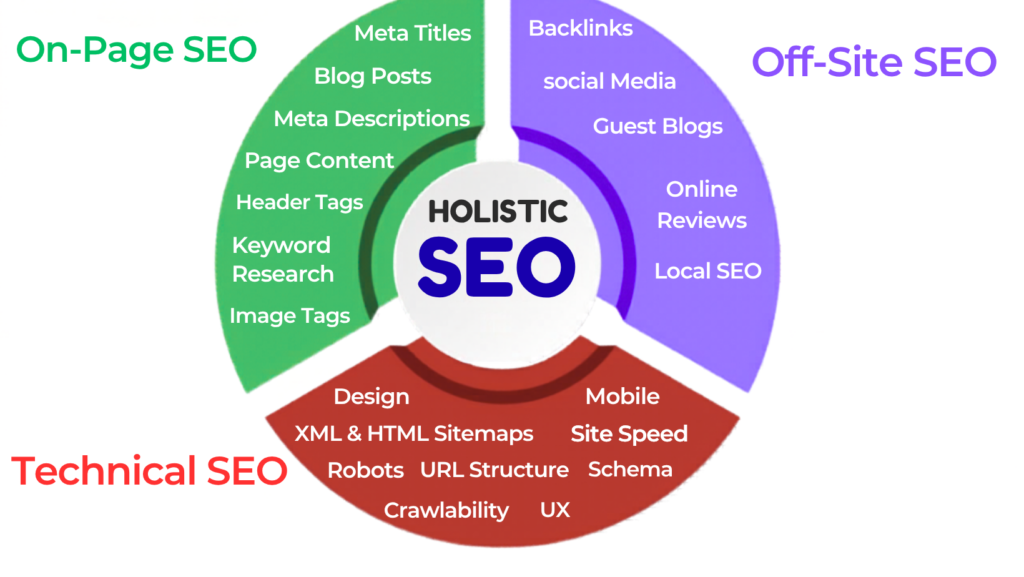
Holistic SEO is a complete SEO strategy that focuses on improving every part of a website instead of only targeting keywords or backlinks. Modern Google algorithms now prioritize websites that provide high-quality content, fast loading speed, mobile optimization, strong technical SEO, and a better user experience. In the past, websites could rank by stuffing keywords or creating spammy backlinks.
Today, those outdated methods no longer work effectively. Google now rewards websites that genuinely help users and provide valuable information. Holistic SEO focuses on building a useful, trustworthy, and user-friendly website. Instead of trying to manipulate search engines, this strategy helps websites grow naturally through quality and consistency.
Google has become smarter than ever. Search engines now analyze user behavior, content quality, mobile usability, website speed, and trust signals before ranking websites. Many websites fail because they focus on only one SEO factor. Some websites publish content regularly but ignore technical SEO. Others build backlinks but provide weak user experiences. Holistic SEO solves this problem by improving all parts of a website together. When every section of a website works properly, search engines trust the site more. This leads to higher rankings, better organic traffic, improved authority, and stronger long-term growth.
Content is the foundation of Holistic SEO. Google wants to rank content that is useful, informative, original, and easy to understand. Your content should answer user questions clearly and naturally. Instead of writing only for search engines, focus on helping real people solve problems. The focus keyword Holistic SEO should appear naturally throughout the article, including the title, introduction, headings, meta description, and conclusion. However, overusing keywords can hurt rankings because Google can detect unnatural optimization. Short paragraphs, readable sentences, and clear formatting improve both SEO and user experience.
User experience plays a major role in modern SEO. If visitors leave your website quickly, Google may assume your content is not useful. A clean website design helps users stay longer and interact with your content more comfortably. Websites that are easy to navigate usually perform better in search rankings. Good user experience includes fast loading pages, readable fonts, mobile-friendly layouts, and organized website structures. A professional website builds trust and increases engagement.
Technical SEO helps search engines crawl and index your website properly. Even high-quality content may struggle to rank if technical SEO is poor. A strong technical foundation improves website performance and helps Google understand your pages better. Secure HTTPS connections, optimized sitemaps, structured data, and mobile responsiveness are all important parts of technical SEO. Fixing broken links, improving Core Web Vitals, and optimizing website architecture also help improve rankings and usability.
Website speed has become one of the most important ranking factors in SEO. Users expect websites to load quickly on both desktop and mobile devices. Slow websites increase bounce rates and reduce user satisfaction. Faster websites create smoother browsing experiences and improve engagement. Image compression, browser caching, fast hosting, optimized code, and CDN usage can significantly improve loading speed. Google rewards websites that provide faster and smoother experiences for visitors.
Most internet users now browse websites from smartphones. Because of this, Google uses mobile-first indexing to evaluate websites. A mobile-friendly website should adapt to different screen sizes and load quickly on mobile devices. Text should be easy to read, buttons should be clickable, and users should not need to zoom or scroll horizontally. Mobile optimization is no longer optional. It is now a necessary part of successful Holistic SEO.
Google values websites that demonstrate Experience, Expertise, Authoritativeness, and Trustworthiness. These principles are known as E-E-A-T. Websites with trustworthy content and strong credibility often perform better in search results. Adding author information, maintaining accurate content, securing the website, and building a strong brand reputation all help improve trust. As Google continues improving its algorithms, E-E-A-T will become even more important for long-term SEO success.
Traditional SEO often focuses mainly on rankings, keyword density, or backlinks. Holistic SEO takes a broader and more user-focused approach. Instead of relying on short-term tactics, Holistic SEO focuses on long-term growth through quality content, technical optimization, strong user experience, and website trust. This strategy creates sustainable traffic growth and better search visibility over time.
Creating a successful Holistic SEO strategy starts with understanding user intent. Before publishing content, it is important to know what users are searching for and why they are searching for it. Keyword research helps identify important search terms and user questions. Long-tail keywords and low-competition keywords can help websites attract targeted traffic more effectively. Creating topic clusters around one main subject strengthens topical authority. Related articles connected through internal links help Google understand website relevance. Proper on-page SEO also remains important. SEO titles, meta descriptions, headings, URLs, image alt text, and keyword placement should all be optimized naturally.
Many websites make SEO mistakes that hurt rankings and reduce visibility. Thin content, slow loading speed, keyword stuffing, duplicate content, weak internal linking, and poor mobile optimization are some of the most common problems. Ignoring user experience can also negatively impact rankings. Websites that focus only on search engines instead of real users often struggle to achieve long-term success. Fixing these issues can improve both SEO performance and user engagement.